
Our international perspective article, which proposes a shared roadmap to make hearing follow-up easier for children receiving cisplatin, was published in Frontiers in Oncology on 27 October 2026. The article is the result of a consensus process by the German-Indonesian Society for Medicine (DIGM) Ototoxicity Working Group. I am delighted to be part of this work, which brought together 26 authors from 23 institutions in the USA, the United Kingdom, Germany, the Netherlands, Indonesia and Türkiye.
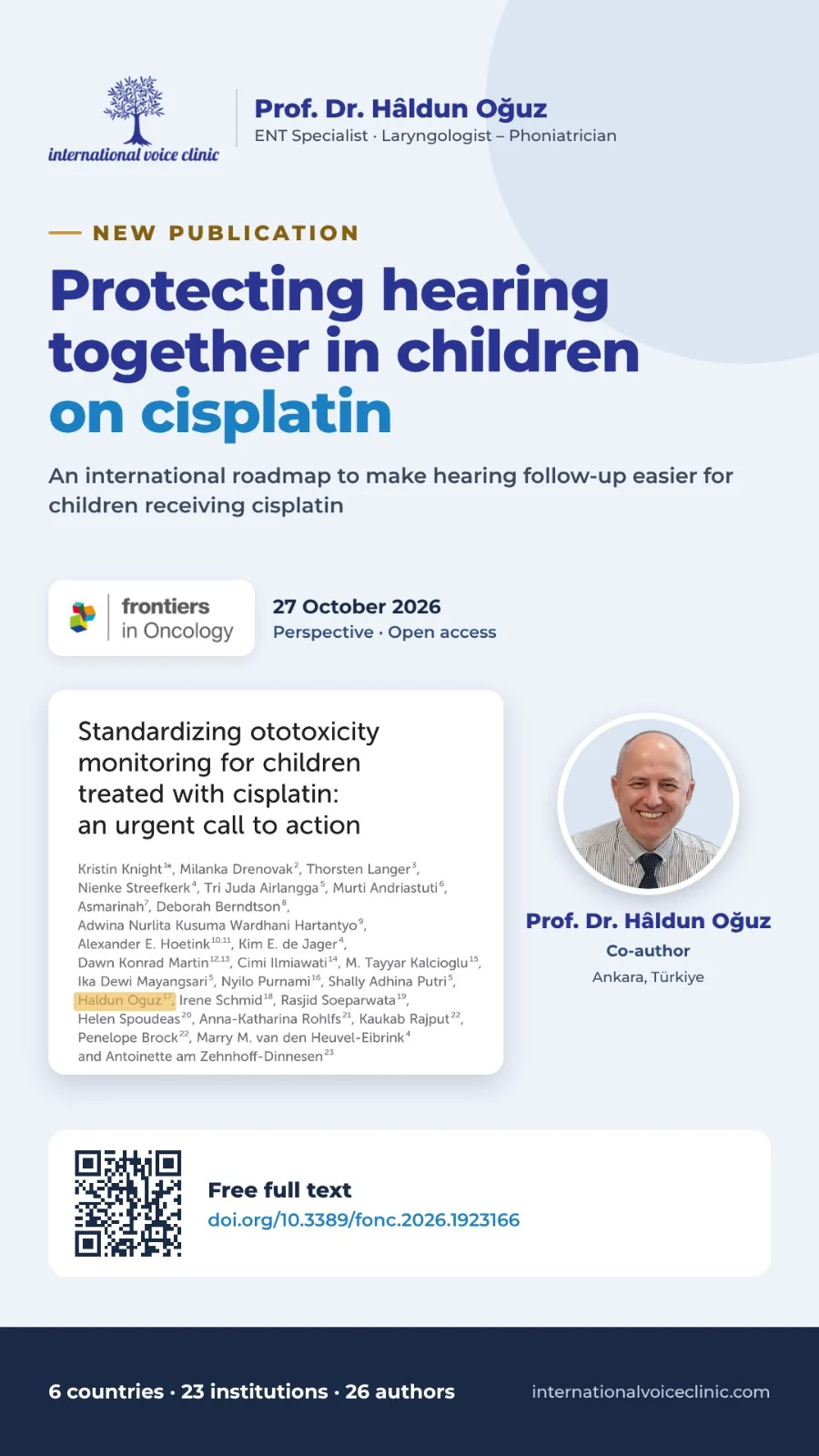
Article: Standardizing ototoxicity monitoring for children treated with cisplatin: an urgent call to action
In brief: An international roadmap to make hearing follow-up easier for children receiving cisplatin.
Cisplatin and hearing: why it matters
Cisplatin is a life-saving chemotherapy drug used to treat many childhood cancers. Because it can also affect the inner ear (ototoxicity), monitoring hearing throughout treatment helps protect a child’s development.
- In 50–60% of children receiving cisplatin, hearing may be permanently affected.
- Cisplatin mainly affects the high frequencies. These frequencies are essential for hearing consonants, for speech clarity and for understanding speech in noise or at a distance.
- The risk is higher in children under 5 years of age, in those receiving higher doses, and when treatment also includes cranial radiotherapy, vincristine or carboplatin.
- Follow-up matters after treatment, too. Because platinum can remain in the inner ear for a long time, hearing changes have been reported to progress after treatment in 20–50% of childhood cancer survivors who received cisplatin.
Good hearing during childhood is the foundation of speech, language and literacy skills, school achievement and social development. Its benefits extend into working and social life in adulthood.
Where we stand: guidelines show the way
International pediatric oncology guidelines (SIOP, COG and the International Late Effects of Childhood Cancer Guideline Harmonization Group) recommend hearing assessments before, during and at the end of treatment. Published studies show that helping these recommendations reach every child is an area where we can move forward together:
- In cohort studies, 19–58% of children receiving ototoxic therapy have not yet had hearing tests during and at the end of treatment.
- In one series of 185 children, 43% had their hearing assessed before, during and at the end of treatment.
- Simpler referral and appointment processes, and audiology services close to the treatment center, can support continuity of care.
Our proposal: a simple roadmap every center can follow
- Before treatment: A comprehensive hearing assessment before cisplatin starts, or as early as possible.
- End of treatment: A comprehensive hearing assessment within 3 months of the last cisplatin dose, even if the treatment plan changes.
- Long-term follow-up: Including hearing assessments in survivorship programs. According to the guidelines, this means yearly for children aged 6 and under, every two years at ages 6–12, and every five years from age 12; yearly if hearing loss is identified.
- In treatment planning: Building hearing monitoring into the cisplatin protocol from the start, so that follow-up becomes easier for both families and care teams.
Tests are chosen to suit the child’s age: audiometry including the high frequencies, otoacoustic emissions and middle ear assessment. For children too young for behavioral testing, objective tests performed during sleep (ABR or ASSR) are used.
For families
If your child is going to receive cisplatin:
- A hearing test before treatment starts is a good first step.
- Plan a hearing test within 3 months of the last dose.
- Continue regular hearing check-ups after treatment, and protect your child from loud noise.
- If you notice that your child has difficulty noticing sounds, understanding speech or listening at school, talk to your doctor.
When hearing loss is identified early, hearing aids, classroom support and speech and language therapy strongly support a child’s development.
Citation
Knight K, Drenovak M, Langer T, Streefkerk N, Airlangga TJ, Andriastuti M, Asmarinah, Berndtson D, Wardhani Hartantyo ANK, Hoetink AE, de Jager KE, Konrad Martin D, Ilmiawati C, Kalcioglu MT, Mayangsari ID, Purnami N, Putri SA, Oguz H, Schmid I, Soeparwata R, Spoudeas H, Rohlfs A-K, Rajput K, Brock P, van den Heuvel-Eibrink MM, am Zehnhoff-Dinnesen A. Standardizing ototoxicity monitoring for children treated with cisplatin: an urgent call to action. Front Oncol. 2026;16:1923166. doi:10.3389/fonc.2026.1923166
The full text is open access: https://doi.org/10.3389/fonc.2026.1923166
The information on this page is for general guidance only. An examination is needed for diagnosis and treatment.