Seeing how you swallow
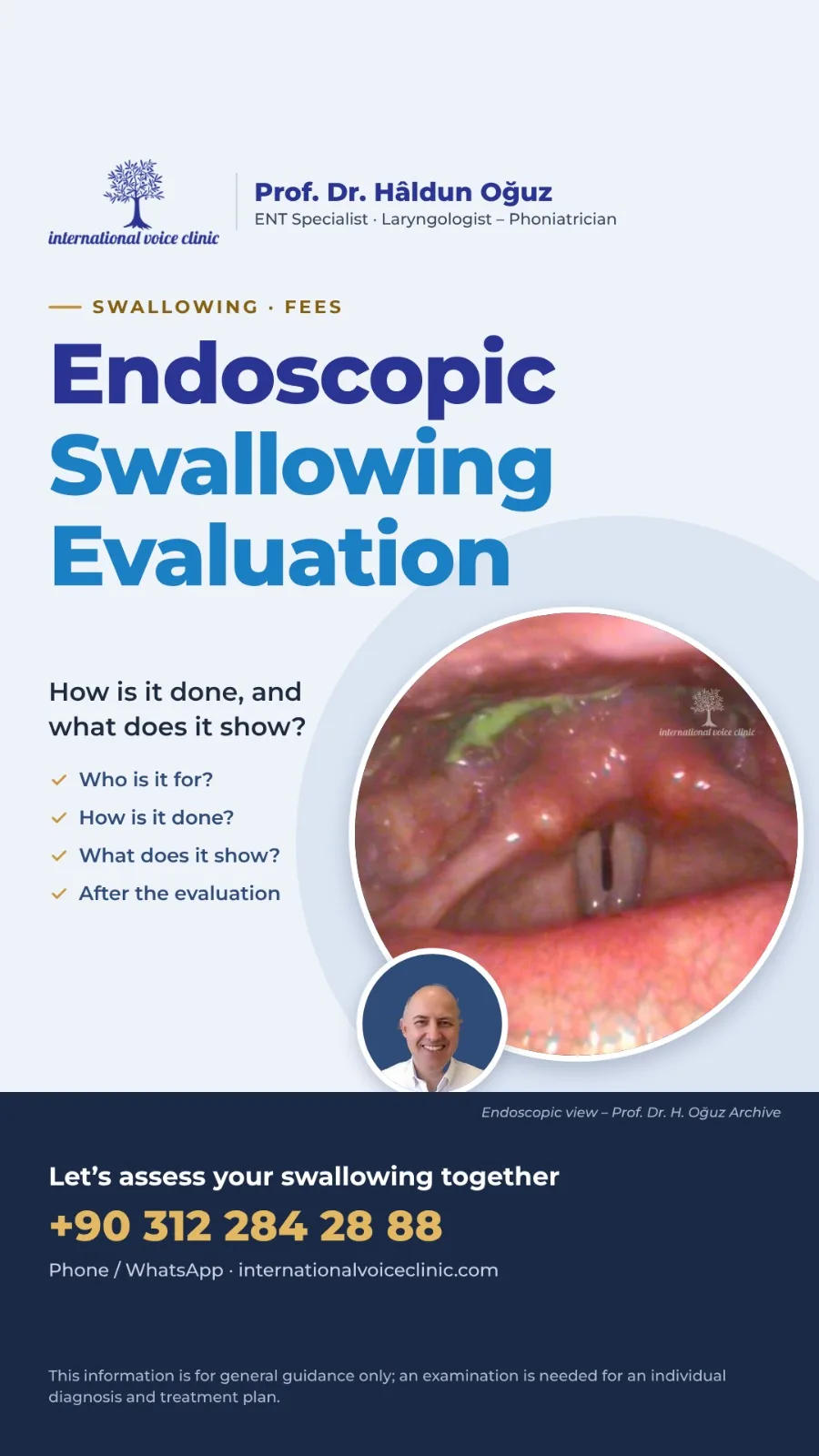
Coughing while you eat, a feeling that food is stuck in your throat, a gurgly voice after meals, or meals that are no longer as enjoyable as they used to be… One of the most practical ways to understand the cause of these complaints is an endoscopic swallowing evaluation, which lets us see swallowing directly. In the international literature, it is known as FEES (Flexible Endoscopic Evaluation of Swallowing).
This evaluation lets us see in real time what happens in the throat as you swallow. It shows which stage of swallowing is difficult, so that a safe eating and treatment plan can be tailored to you.
Who is it for?
An endoscopic swallowing evaluation can be done at any age for anyone who has difficulty swallowing or whose swallowing safety needs to be assessed. It is most often helpful in these situations:
- Coughing or a choking sensation while eating or drinking
- A feeling that food gets stuck or stays in the throat
- A change in the voice, a gurgly or wet-sounding voice after meals
- Difficulty swallowing pills
- Unexplained weight loss or meals taking longer than before
- Recurrent chest infections (pneumonia)
- Assessing swallowing in stroke, Parkinson’s disease and other neurological conditions
- Following swallowing after surgery or radiation therapy to the head and neck
How is it done?
- Preparation: No special preparation is needed. You sit comfortably, and we talk about your symptoms and the medications you take.
- Placing the endoscope: A thin, flexible camera (endoscope) is gently passed through the nose and positioned at the upper part of the throat. Because your mouth stays free, you can eat and drink normally.
- Observation before swallowing: The larynx, vocal folds and throat structures are examined; how you swallow saliva, how the vocal folds move and how the cough reflex works are assessed.
- Trying different textures: You are asked to swallow small amounts of different textures, such as water, thickened liquids, purées and solid foods. The foods may be colored with food coloring to make them easier to see.
- Trying helpful strategies: When needed, head and chin positions or different swallowing techniques are tried on the spot, and their effects are watched on the screen.
- Recording and review: The whole examination is recorded. The recording is then reviewed in detail, and the findings are discussed with you.
The examination usually takes only a short time. You may feel temporary pressure in the nose, but it is not painful. Because it involves no radiation, it can be repeated when needed.
What does it show?
An endoscopic swallowing evaluation looks for answers to these questions:
- How does food move through the throat?
- Does the swallowing reflex start on time?
- Is there food residue left in the throat after swallowing?
- Does food or liquid enter the airway, and if it does, does the cough reflex respond?
- Which textures are swallowed more safely?
- Which position or technique makes swallowing easier?
What does research show?
The endoscopic swallowing evaluation was first described in 1988, and since then it has become one of the main methods for assessing swallowing.
How is it different from videofluoroscopy?
Swallowing can also be assessed with videofluoroscopy, which uses X-rays. Videofluoroscopy shows every stage of swallowing, from the mouth to the esophagus. The endoscopic evaluation, on the other hand, involves no radiation, can be done in the examination room or at the bedside, and shows the movements of the vocal folds and any residue in the throat directly, in color. The two methods complement each other; which one suits you is decided based on your symptoms and examination findings.
After the evaluation
The results form the basis of a plan tailored to you:
- Safe textures: We identify which foods and drinks you swallow more comfortably; when needed, thickeners are recommended.
- Positions and techniques: You learn head and body positions and swallowing techniques that can help during meals.
- Swallowing therapy: Exercises that strengthen the swallowing muscles and support coordination are planned.
- Treating the underlying cause: If there is reflux, a neurological condition or a structural cause, the appropriate treatment is planned; when needed, we work together with neurology, gastroenterology and nutrition specialists.
- Follow-up: Because it involves no radiation, the evaluation can be repeated when needed to follow your progress.
Frequently asked questions
Is it painful?
No. You may feel brief pressure or a tickling sensation in the nose; almost all patients complete the examination comfortably.
Do I need to fast before the examination?
Usually not. Since you will swallow small amounts of food during the evaluation, you can eat normally beforehand.
How long does it take?
The examination usually takes only a short time; together with the consultation and discussing the results, it is completed in a single visit.
Can I eat right after the examination?
Yes. You can return to your daily routine and your usual meals right after the evaluation.
Can it be done in children?
Yes. When appropriate, it can also be done in children; it can be planned according to the child’s age and ability to cooperate with the examination.
Is the endoscopic swallowing evaluation the same as a vocal fold examination?
The same thin endoscope is used, but in a swallowing evaluation we also watch how foods of different textures are swallowed, in addition to the vocal folds.
If you notice that eating has become difficult, that you cough while eating or that food gets stuck, contact us for a comprehensive ENT and swallowing evaluation.
The information on this page is for general guidance only; an examination is needed for an individual diagnosis and treatment plan.